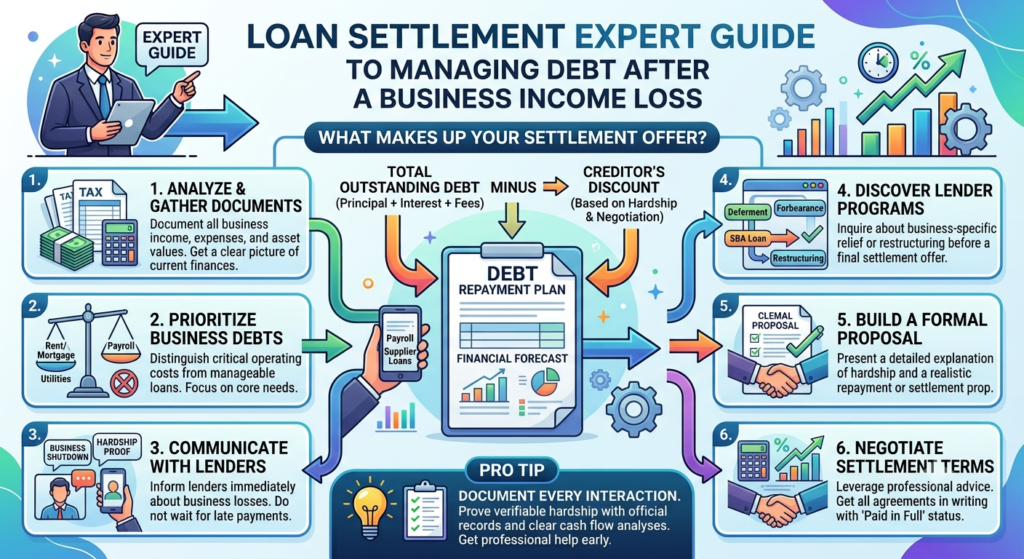

Facing severe financial distress, sudden revenue drops, and unmanageable business loan or commercial credit liabilities can make any entrepreneur or small business owner feel completely overwhelmed. When economic shocks, market downturns, or sudden operational disruptions impact your monthly business income, keeping up with multiple debt obligations becomes an immense challenge. Whether you are juggling short-term working capital lines or long-term structural business loans, taking a proactive approach to your financial recovery is essential. Before initiating discussions for a formal loan settlement, understanding how to manage your obligations after a business income loss is critical to achieving financial stability and becoming completely debts free.
When working through a severe commercial cash flow crisis, attempting to navigate recovery without a structured strategy leaves you vulnerable to aggressive creditor tactics, asset attachments, and uncalculated financial losses. Managing your liabilities post-revenue drop allows you to approach a settle loan conversation with absolute clarity and control. Whether you are managing discussions independently or consulting a professional loan settlement strategist via resources like Debts Free, mastering your business recovery transition plan is vital. Below is an exhaustive guide on how to handle business debt after an income loss and structure your path to become debts free.
1. Consolidating All Commercial Credit Data Into a Master Business Index
The very first step after experiencing a sudden business income loss is gathering every single piece of credit documentation, loan sanction letter, and overdraft statement you possess across all active institutional lenders into one centralized index.
- Pulling Business and Personal Credit Reports: Download your latest CIBIL, Experian, and CRIF High Mark credit reports (both commercial and consumer, if personal guarantees were signed) to get an uncompromised master list of every active, overdue, or defaulted account registered under your business PAN and personal identity.
- Professional Guidance: To understand how structured business recovery planning helps distressed borrowers become debts free, review the detailed insights available on the Debts Free Homepage. Recognizing your exact liabilities ensures you miss nothing while working toward a viable loan settlement.
2. Auditing and Categorizing Your Dues by Component
Once your business obligations are listed, your post-loss recovery plan must separate the original principal from inflated penalty charges, late fees, and compounding penal interest.
- Isolating the Core Principal: Track how much of the original disbursed business loan amount remains unpaid, separating it from bank-levied late fees, over-limit charges, and penal interest that accumulate rapidly after missing commercial EMIs.
- Structured Frameworks: Maintaining a rigorous numerical breakdown helps you verify whether final compromise offers align with actual ledger data. Learn more about structural frameworks by visiting Debts Free About Us. You can also evaluate options to settle loan accounts effectively once your ledger is audited.
3. Calculating Your Monthly Settlement Surplus Pool and Business Cash Flow
A business debt management strategy is incomplete without an accurate picture of your remaining liquid capital, ongoing operational expenses, and diminished revenue streams.
- Establishing Survival Baselines: Subtract your non-negotiable operational costs (essential vendor payments, employee wages, and vital utilities) from your remaining business revenue to determine your true monthly savings and settlement surplus pool.
- Mitigating Exposure: A professional loan settlement planner meticulously scrutinizes these commercial cash flows to help you build a centralized reserve fund. You can reach out for guidance via the Debts Free Contact Page.
4. Shifting From Minimum Payments to a Structured Business Resolution Strategy
One of the most dangerous traps business owners fall into after a revenue loss is leaking small, random amounts across multiple business credit lines instead of pooling resources for long-term resolution.
- The Risk of Haste: Making partial, unstructured payments on low-priority business credit cards using your last operational reserve provides zero long-term relief while unmanaged term loans accumulate heavy penalties.
- Building a Centralized Reserve: Instead, use your business transition plan to channel your remaining liquid funds into a single resolution fund. As accounts mature toward default, you can deploy this reserve to fund a formal loan settlement and move closer to being debts free.
- Strategic Progress: Keeping your records organized brings you one step closer to your goal. To explore comprehensive debt relief structures, review the services outlined on Debts Free.
5. Securing Permanent Legal Closure and NDCs Using Your Business Plan
Managing business debt dues after an income loss does not end when your funds are saved; it requires tracking the entire lifecycle of every commercial account until final legal closure is achieved.
- Saving Digital Records: Save all email threads, scanned notices, UTR transfer numbers, and payment receipts alongside your business recovery financial plan in a secure digital folder.
- No Dues Certificate (NDC): Verify that the final written communication you receive for each resolved business loan matches your budget, explicitly confirming a zero balance and helping you successfully settle loan liabilities.
- Credit Report Reflection: Track your commercial and personal credit reports post-payment to ensure every account status is updated accurately. Explore more resources via Debts Free.
Conclusion
Mastering how to manage debt after a business income loss is a vital step toward regaining control of your financial and entrepreneurial future. By consolidating your commercial credit data, auditing your ledger components, calculating a monthly surplus, rejecting unviable partial payments, and securing formal closure certificates, you step into debt resolution from a position of absolute strength.
If managing complex documentation trails and negotiating with institutional creditors feels overwhelming, structured guidance can make all the difference. To explore tailored resolution plans, protect your rights against recovery harassment, and take confident steps toward a successful loan settlement to become completely debts free, consult trusted resources through Debts Free. Taking control of your business debt strategy today is your safest path to long-term financial recovery.