
Stepping into a cycle of overwhelming financial liabilities can make your entire household feel as though it is standing on unstable ground. When mounting credit card bills, unsecured personal loans, and compounding interest outpace your monthly income, panic is a natural reaction. However, reacting out of fear and making random, unstructured payments will only deepen your financial distress.
If your ultimate goal is to become completely debts free, your recovery must start with a single, foundational step: conducting a ruthless, honest review of your current financial situation. Before choosing a debt resolution path—whether you opt for restructuring or a formal loan settlement—you must map out your exact financial reality. Without a clear picture of your cash flow and liabilities, choosing a strategy is like navigating a maze blindfolded. Below is an exhaustive guide on how to audit your finances and set the stage for a successful loan settlement journey.
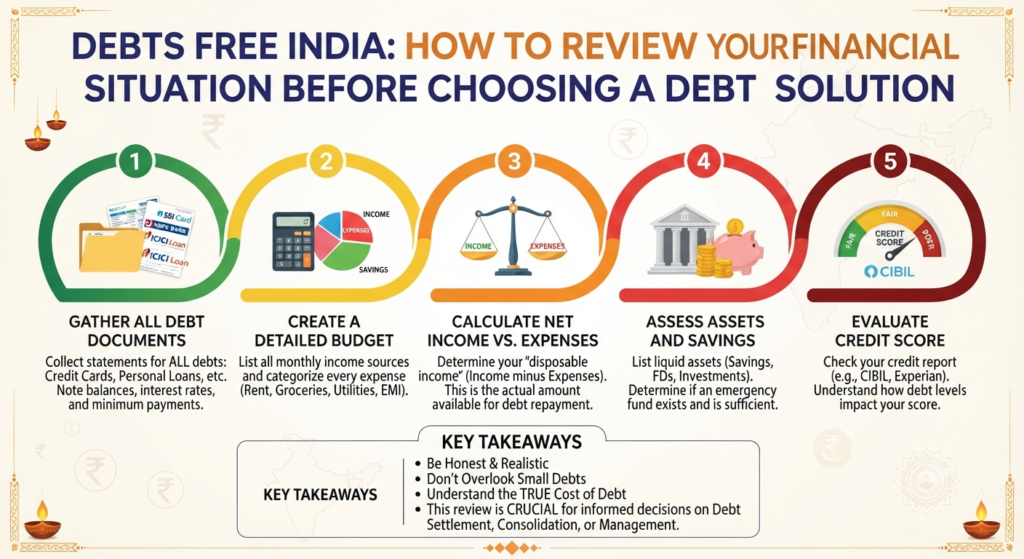
1. Gathering Every Piece of Financial Data
The first phase of reviewing your financial situation requires rounding up every active piece of credit documentation you possess. Borrowers often lose track of how many separate lines of credit they actually hold, especially when juggling multiple retail cards and online consumer finance apps.
- Pull Official Credit Reports: Download your latest CIBIL, Experian, and CRIF High Mark reports. This provides an uncompromised master list of every active loan, credit card, and closed or defaulted account registered under your PAN.
- Retrieve Historical Statements: Dig through your emails, banking apps, and physical files to pull the most recent statements for every single liability.
- Create a Centralized Sheet: Open a spreadsheet and list each creditor individually. Capturing every data point early ensures you do not miss hidden accounts that could later trigger unexpected legal notices or collection calls while you work toward becoming debts free. For more budgeting tools and resources, visit DebtsFree.
2. Differentiating Survival Expenses from Legacy Debt Payments
When reviewing your monthly budget during financial distress, standard budgeting rules must be put on hold immediately. You must establish a strict survival baseline that protects your family’s immediate future.
- Non-Negotiable Living Costs: Group your expenses into categories required strictly for daily existence: secure housing (rent or essential utility bills), basic nutritious groceries, critical healthcare, and school fees.
- The Core Philosophy: A qualified settle loan expert will always remind you that banks and collection agencies cannot legally demand that you starve your family or forgo medicine to service unsecured retail debt. Protecting your household foundation is always priority number one on your path to becoming debts free. Read more about protecting your cash flow at DebtsFree.
3. Taking an Honest Inventory of Remaining Liquid Assets
Once your survival expenses are locked in, you must calculate an honest inventory of your available liquid funds. Lenders do not evaluate settlement proposals based on what you used to earn; they evaluate them based on your current liquidity and hardship.
- Assess Your Savings Honestly: Take stock of your remaining bank balances, fixed deposits, or cash reserves.
- Ring-Fence Emergency Cash: Never empty your absolute last rupee of emergency reserves just to satisfy an aggressive collection agent. You must retain a baseline cushion to protect against sudden medical or family shocks. Explore asset management tips via DebtsFree.
- Transparency as Leverage: Presenting a clear, accurate picture of your true financial standing proves to the lender that you are acting in good faith and cannot afford a high-percentage payout. Check out timeline planning guides on DebtsFree.
4. Calculating Your Monthly Surplus Settlement Pool
A financial review is not just about what you have today; it is also about what you can consistently save month over month while your account matures toward default.
- Determine Monthly Inflows: Calculate your net take-home household income from all active sources.
- Isolate Your Monthly Surplus: Subtract your survival baseline expenses from your net income. The remaining positive balance is your strict monthly settlement pool.
- Incremental Accumulation: Because lenders rarely offer deep principal waivers until accounts cross the 90-day Non-Performing Asset (NPA) threshold, you can use the waiting period to steadily build your lump-sum loan settlement reserve month by month. Read more about strategic allocation on DebtsFree.
5. Choosing the Right Resolution Path and Securing Closure
Once your financial audit is complete, your data will tell you exactly which resolution path is mathematically viable. If your income surplus cannot cover minimum payments, traditional consolidation will fail, making a structured loan settlement your most realistic option.
- Verify Official Documentation: Once your budget allows you to accumulate the agreed settlement amount, ensure you receive an official One-Time Settlement (OTS) letter on the bank’s letterhead before transferring funds. Learn more about secure documentation via DebtsFree.
- The Path to Permanent Freedom: After paying your negotiated amount, secure your formal No Dues Certificate (NDC). By sticking to a disciplined review process and finalizing your accounts through a formal loan settlement, you permanently clear your balance sheet, allowing you to step forward and live completely debts free. Explore complete recovery resources at DebtsFree.
Conclusion
Reviewing your financial situation before choosing a debt solution transforms your recovery from an emotional guessing game into an administrative science. By gathering your data, prioritizing your survival needs, assessing your liquid reserves, and calculating a steady monthly surplus, you build the financial discipline required to tackle unmanageable debt.
If auditing your finances, dealing with aggressive creditors, and negotiating complex liabilities feels overwhelming, professional guidance can make all the difference. To explore tailored resolution plans, protect your rights, and take confident steps toward becoming completely debts free, visit DebtsFree
. Taking control of your financial review today—with additional insights accessible via DebtsFree
—is your safest path to long-term financial peace of mind.