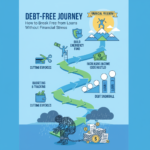


Becoming debt-free in India requires discipline, smart strategies, and leveraging local financial tools. Millions grapple with personal loans, credit card debt, home loans, and education loans amid rising inflation and lifestyle costs. This blog outlines actionable steps tailored for Indians to accelerate their journey to financial freedom without extreme sacrifices.
Assess Your Debt Reality
Start by compiling a full debt inventory. List all loans including EMIs for home, car, personal loans from banks like SBI or HDFC, credit card dues, and even microfinance from apps like Paytm or PhonePe. Calculate total outstanding principal, interest rates (often 10-36% for personal loans), and monthly payments.
Use free tools like Excel or apps such as Walnut and Money View to track this. Prioritize high-interest debts first—the “avalanche method”—as they grow fastest. For instance, credit card rates at 3-4% monthly can double debt yearly if unpaid. In India, unsecured loans dominate, so focus here before secured ones like home loans with lower 8-9% rates .
Build a Ruthless Budget
Track every rupee for one month using apps like ET Money or Goodbudget. Categorize into needs (60%), wants (20%), savings/debt (20%)—the 60/20/20 rule adapted for debt payoff.
Cut non-essentials: Switch to cheaper DTH over OTT subscriptions, cook at home instead of Zomato, use public transport or Ola Share over Uber. In Dadri, Uttar Pradesh, leverage local markets for affordable groceries versus malls. Aim to free up 20-30% of income (₹10,000-20,000 for average salaried) for extra debt payments. Automate transfers to a separate debt repayment account via UPI for discipline.
Boost Income Streams
Side hustles accelerate payoff. Freelance on Upwork or Fiverr if skilled in IT, writing, or graphic design—many Indians earn ₹20,000+ monthly. Sell handmade goods on Meesho, tutor via UrbanPro, or drive for Uber in nearby Delhi NCR.
For passive income, invest small savings in mutual funds via Groww or Zerodha post-emergency fund. Government schemes like PMJDY offer zero-balance accounts; link to Atal Pension for long-term security. Target 10-20% income increase to throw at debt—e.g., ₹50,000 salary becomes ₹60,000 with gigs.
Master Debt Repayment Strategies
Adopt the debt snowball: Pay minimums on all, extra on smallest debt for quick wins. Example: Clear ₹20,000 personal loan first, then roll payments to next. For faster results, avalanche saves interest.
Negotiate with lenders—Indian banks like ICICI allow EMI restructuring or balance transfer to 0% intro offers from rivals. Check RBI guidelines for one-time settlements if nearing default, reducing principal by 20-30%. Avoid new debt; use cash or debit cards.
| Strategy | Pros | Cons | Best For |
|---|---|---|---|
| Debt Snowball | Builds momentum | Higher total interest | Motivation seekers |
| Debt Avalanche | Saves money | Slower visible progress | Math-focused |
| Balance Transfer | Lower rates short-term | Processing fees (1-2%) | Credit card debt |
| Consolidation Loan | Single EMI | Tempts more borrowing | Multiple high-rate loans |
Leverage Indian Financial Hacks
Build a 3-6 month emergency fund in liquid savings (4-6% interest via SBI or post office). Use Section 80C deductions—₹1.5 lakh yearly via PPF or ELSS reduces taxable income, freeing cash.
Participate in chit funds cautiously or women’s SHGs for low-cost group lending. Apps like Cred reward bill payments with cashback; redirect to debt. For home loans, partial prepayments (up to 20% yearly penalty-free) shave years off tenure.
Tax refunds from Form 16—claim HRA, LTA properly to get ₹10,000-50,000 back annually for lump-sum payoffs.
Sustain Long-Term Freedom
Once debt-free, insure against relapse: 50/30/20 rule (needs/wants/savings), annual debt audits. Celebrate milestones—like first debt cleared—with low-cost treats.