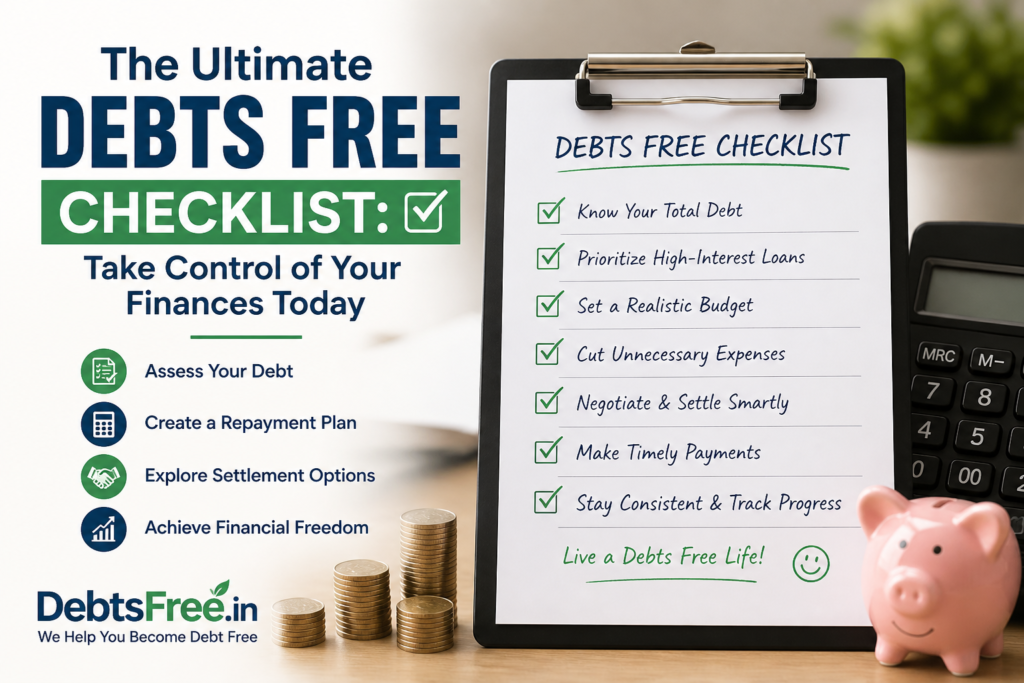

As of May 2026, the Indian credit landscape has undergone a radical transformation. With the Reserve Bank of India (RBI) moving toward weekly credit reporting and stricter borrower protection laws, the margin for error in managing your finances has disappeared. If you are struggling with multiple EMIs or high-interest credit cards, achieving a debts free status is the only way to safeguard your future. Navigating the new 2026 regulations requires a precise strategy, and partnering with experts like debts free can help you leverage these laws to your advantage. By following a structured debts free checklist, you can stop the cycle of interest and reclaim your financial dignity.
1. Audit Your Debt Portfolio (The 2026 Reality Check)
Before you can fix the problem, you need to see it clearly. Under the latest RBI Credit Information Reporting Directions (2026), lenders now update your status every 7 days. This means your “Debt-to-Income” ratio is visible to every bank in near real-time.
- List Every EMI: Include personal loans, BNPL (Buy Now Pay Later) accounts, and credit card “minimum dues.”
- Identify the “Toxic” Debt: Highlight any loan with an interest rate above 18%. In today’s market, credit card debt often hits 42% APR—this is the first barrier to being debts free.
- Check Your CIBIL Weekly: Since updates are now weekly (usually on the 9th, 16th, 23rd, and the last day of the month), ensure no “ghost accounts” or errors are dragging you down.
2. Enforce Your “Borrower Bill of Rights”
Many people fail to become debts free because they are intimidated by aggressive recovery tactics. The July 2026 RBI Second Amendment Directions have made harassment a punishable offense for banks and NBFCs.
Your Checklist for Recovery Interactions:
- Verify the Agent: Ensure the agent carries an IIBF certification and a bank authorization letter.
- Log the Time: If an agent calls or visits before 8:00 AM or after 7:00 PM, document it. This is a direct violation of 2026 norms.
- Privacy First: Agents are strictly prohibited from contacting your neighbors, family, or employer. If they do, you have the grounds to file a complaint with the Banking Ombudsman, who can award compensation up to ₹20 lakhs for harassment.
3. Choose Your Settlement Strategy
To reach a debts free state, you must decide between a “slow build” or a “hard reset.”
- The Debt Snowball: Pay off the smallest debt first to gain psychological momentum.
- The One-Time Settlement (OTS): If your debt has become unmanageable, a settlement is your fastest route to being debts free. In 2026, banks are more open to “haircuts” (waivers) of 40%–60% on principal amounts for accounts in genuine distress.
- Interest Waiver Schemes: Look for time-bound schemes (like the current NSDL interest waiver programs) that allow you to close legacy balances by paying only the principal.
4. Documentation: The “Paper Shield”
You cannot be debts free if the bank claims you still owe them money years later. Your checklist must include:
- The Hardship Letter: A formal document explaining why you cannot pay (job loss, illness, etc.).
- The Settlement Letter: Never pay a single rupee toward a settlement until you have a signed offer on the bank’s official letterhead.
- The No Dues Certificate (NDC): This is the most important document. It is your legal proof that you are debts free.
5. Rebuild Your Score Post-Settlement
A common myth is that settlement ruins your life. In the 2026 “Weekly Update” era, you can rebuild faster than ever.
- Report Updates: Ensure your bank reports the “Settled” status to credit bureaus within 7 days.
- Secured Credit: Use an FD-backed credit card to demonstrate responsible behavior. Because of weekly reporting, your score will begin to climb much faster than in the old monthly system.
Comparison: Debt Trap vs. The Checklist Life
| Feature | The Debt Trap (Passive) | The Debts Free Path (Active) |
| Reporting | Monthly lag hides the damage | Weekly monitoring catches errors early |
| Interest | Compounding “Minimum Due” cycle | Strategic settlement or consolidation |
| Legal Rights | Suffering in silence from calls | Reporting violations to the Ombudsman |
| Duration | 5–10 years of financial stress | 90–180 days to full closure |
Conclusion: Freedom is a Choice
Becoming debts free in 2026 isn’t just about having the money; it’s about having the right information. The laws have shifted in favor of the transparent, proactive borrower. By following this checklist and asserting your rights, you can cut through the noise of collection agents and interest traps.
Don’t let your debt define your decade. Visit debts free today to get expert help in negotiating with banks and ensuring your settlement is handled legally and permanently. Your debts free journey starts with a single step—make it a smart one. Reach out to debts free and take back control of your finances now.